
Walk into any cookware shop today and “triply” is printed on half the boxes. Kadhai, tawa, frypan, pressure cooker. One set costs ₹1,500, another ₹6,000, and both claim to be the same thing.
So what is triply cookware, really? Is it worth the extra money? And how do you tell a properly built pan from one that only borrowed the name?
We have been making stainless steel cookware in Delhi since 1998, and we have watched triply go from a premium curiosity to something ordinary kitchens now ask for by name. This guide explains how it works, what it does well, where it falls short, and the exact checks to make before you pay.
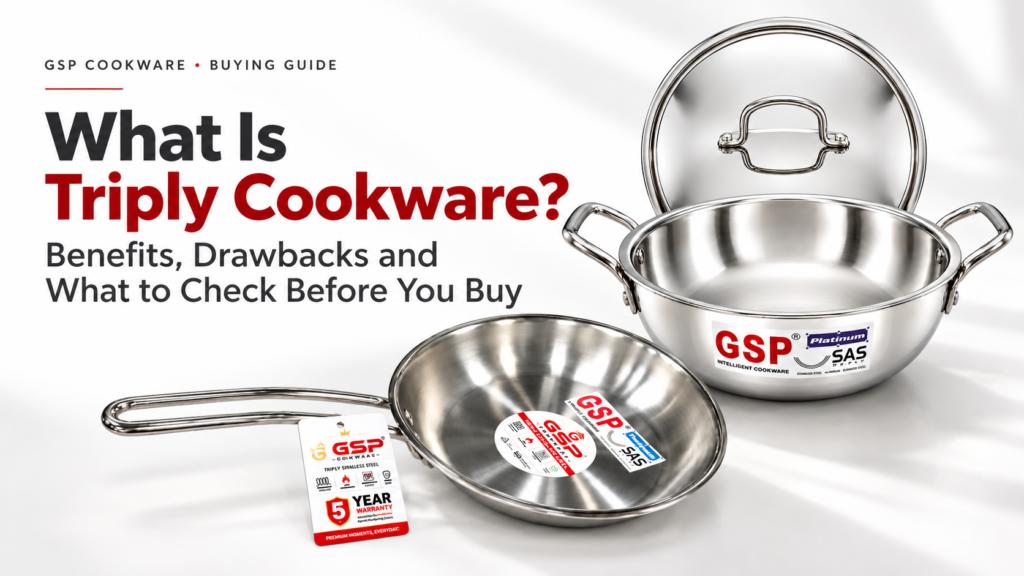
What Is Triply Cookware?
Triply cookware (also written tri-ply or 3-ply cookware) is made from three layers of metal bonded into one sheet: stainless steel, aluminium, stainless steel. That sheet is then formed into a kadhai, tawa, saucepan or pressure cooker.
The Three Layers and What Each One Does
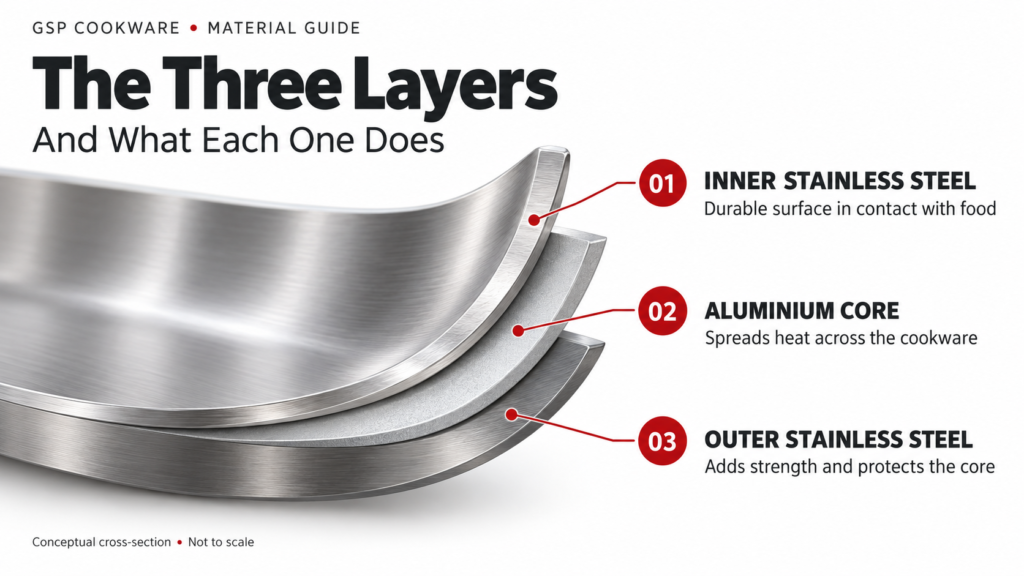
- Inner layer: food-grade stainless steel (commonly SS 304). The only layer your food touches. It does not react with tomato, tamarind or curd, and there is no coating to peel.
- Middle layer: aluminium core. Aluminium moves heat far better than steel, so this layer spreads heat before it reaches your food.
- Outer layer: magnetic stainless steel (commonly SS 430). It adds strength and a clean finish, and being magnetic, it makes the pan work on induction.
The aluminium never touches your food. It is sealed between the two steel layers.
Full-Body Triply vs Sandwich-Bottom
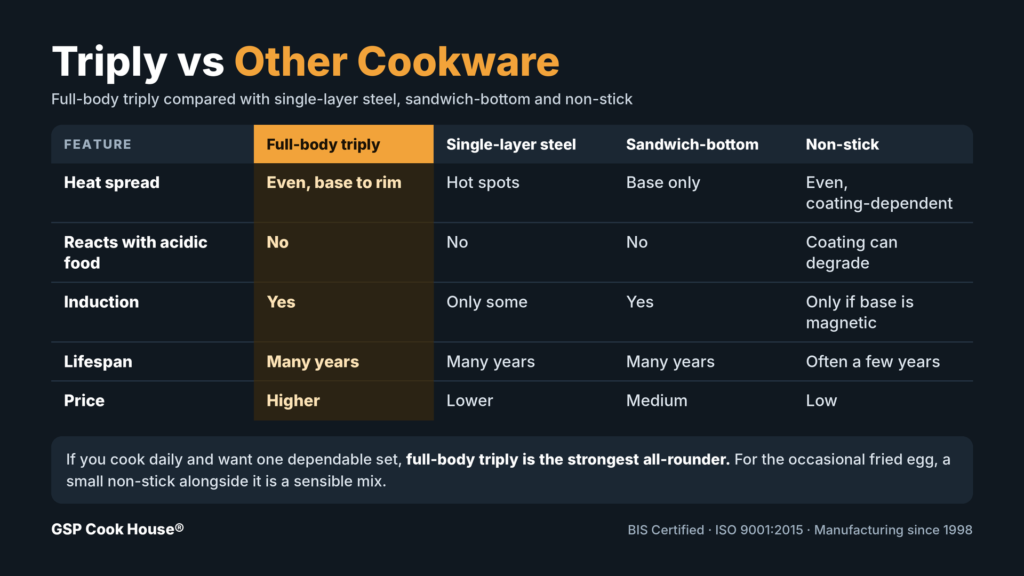
Most buyers miss this. In full-body triply, all three layers run from base to rim. In a sandwich-bottom pan, an aluminium disc is fixed only under the base, and the walls stay single-layer steel.
Sandwich-bottom is cheaper and fine for boiling milk or water, but the walls do not share the heat. Plenty of boxes say “triply base” and hope you read it as “triply”. Always ask which one you are holding.
Is There an Indian Standard for Triply?
Yes. The Bureau of Indian Standards has published IS 18755:2024 for tri-ply (SS-AL-SS) material used in utensils, including how well the layers must stay bonded. Stainless steel utensils also fall under BIS quality control rules. A reputable triply product should show you a BIS mark, not just a nice brochure.
How Does Triply Cookware Work?
Stainless steel is tough and hygienic, but a poor conductor of heat. On a single-layer pan, heat piles up right above the flame. The centre scorches while the edges stay cool. You have met this pan: the sabzi catches in the middle, and the roti has one black spot and one raw patch.
Aluminium is the opposite. It spreads heat quickly, but it is soft and reacts with acidic food.
Triply keeps the good half of each. The core carries heat across the base and up the walls, and the steel layers hold it steady, so the temperature does not crash when cold vegetables go in.
For Indian cooking, this matters. A tadka wants fierce heat for ten seconds. A dal wants a patient simmer. Triply handles both with far less babysitting.
Benefits of Triply Cookware
1. Even Heating, Fewer Burnt Spots
Food browns evenly and is less likely to catch in one corner. Thick gravies, rice dishes and anything with milk become far more forgiving.
2. A Safe, Non-Reactive Surface
Cook tomato gravy or kadhi in bare aluminium and you can taste the metal. In triply, food meets only stainless steel, with no non-stick coating to overheat or flake.
3. Works on Gas, Induction, Electric and Ceramic
Many homes now run both a gas stove and an induction plate. A well-made triply pan moves between them without any change.
4. Better Heat Control and Some Fuel Saving
Once hot, a triply pan holds its temperature. Most people lower the flame and still get the same result, which adds up over months.
5. Built to Last
With no coating to wear off, a properly made triply kadai can serve a family for many years. That changes the maths against a pan you replace every two years.
Drawbacks of Triply Cookware
We would rather you buy with open eyes than return the pan in a week.
- It costs more. More material and a more involved process put it well above ordinary steel or non-stick.
- It is heavier. A full 20 cm Handi is not light with biryani in it, and it takes a little longer to heat up.
- It is not non-stick. If you pour oil into a cold pan and add food at once, it will stick. It needs a short learning curve.
- It can show heat tint. Overheated steel gets faint bluish marks, and hard water leaves white spots. Both are cosmetic and clean off with vinegar.
- Cheap triply is genuinely poor. Thin or badly bonded layers can separate over time (delamination), leaving the pan warped or uneven. That is why the checklist below matters.
Is Triply Cookware Safe for Daily Use?
For everyday cooking, yes. The food surface is stainless steel, the aluminium is fully enclosed, and there is no coating. Discard any pan that has visibly split or separated. One honest note: stainless steel contains nickel, so anyone with a known nickel sensitivity should check with their doctor first.
What to Check Before You Buy Triply Cookware
Two minutes in the shop saves most bad purchases.
- Is it full-body? Ask: “Are the layers on the walls too, or only the base?”
- Which steel grade? The inside should be food-grade stainless steel, commonly SS 304. “Premium steel” with no grade is a warning sign.
- Do the magnet test. A fridge magnet should stick firmly to the base and outer wall. That confirms induction compatibility.
- Look at the rim. You should see three clean, tight layers with no gaps or bubbles. A wavy edge means a weak bond.
- Feel the weight. A large kadhai that feels feather-light probably has thin layers.
- Check flatness and handles. The pan should not rock on a counter, and the handles should be firmly riveted.
- Look for the BIS mark and maker details. Anonymous listings with no factory address are risky for something you cook in daily.
How to Use and Care for Triply Cookware
These habits matter more than the price of the pan.
- Preheat on medium. Warm the empty pan for a minute or two. A few water drops should ball up and glide like mercury.
- Oil first, then food. Let the oil shimmer before adding ingredients.
- Let the first sear be. Food releases by itself once browned.
- Never put a hot pan under cold water. It can warp the base.
- Clean gently. Use warm soapy water and a soft scrub. For stubborn marks, simmer water with a spoon of baking soda, or wipe with diluted vinegar.
Why Buy Triply Cookware From GSP Houseware?
GSP Cook House is the cookware brand of Exotica Steel India, manufactured at our own facility in Bawana Industrial Complex, New Delhi. We are BIS certified and ISO 9001:2015 certified, and we have been in this business since 1998. Because we are the manufacturer, you can ask us the questions in this guide, from steel grades to bond quality, and get a straight answer. All Size triply range, 304 grades, 2.5mm thickness and 5 years Of warranty.
Frequently Asked Questions About Triply Cookware
Is triply cookware good for health?
Yes. The cooking surface is food-grade stainless steel with no coating to flake, and the aluminium core is sealed between steel layers.
Can triply cookware be used on induction?
Yes, if the outer layer is magnetic steel. Do the magnet test on the base before buying.
What is the difference between triply and regular stainless steel cookware?
Regular steel has one layer and heats unevenly. Triply adds an aluminium core, so heat spreads across the base and walls with fewer hot spots.
Does food stick in triply cookware?
It can if the pan is cold when you add oil or food. Preheat on medium, test with water drops, then add oil and food.
Is triply cookware worth the price?
If you cook daily and want cookware that lasts years without a coating to replace, yes. For rare use, a cheaper pan may do.
The Bottom Line
Triply is not magic, and it is not non-stick. It solves the oldest problem with steel cookware, uneven heat, while keeping everything that makes steel trustworthy in a family kitchen. Buy full-body construction, confirm the steel grades, check the bond and the BIS mark, and learn the preheating habit. Do that and one good kadai can earn its price many times over.
Questions about our triply range, bulk orders or dealership? Message us on WhatsApp at+91-9217379274 or Mail Us info@exoticasteelindia.com